Thiruparankundram Deepam row: Madras High Court agrees to urgently hear pleas challenging Section 163 BNSS prohibitory orders in Madurai.
The Madras High Court will hear a batch of petitions challenging prohibitory orders imposed in Madurai amid the controversy surrounding the lighting of Karthigai Deepam at Thiruparankundram. The Madurai District Collector and Police Commissioner have reportedly been summoned to appear before the Court.
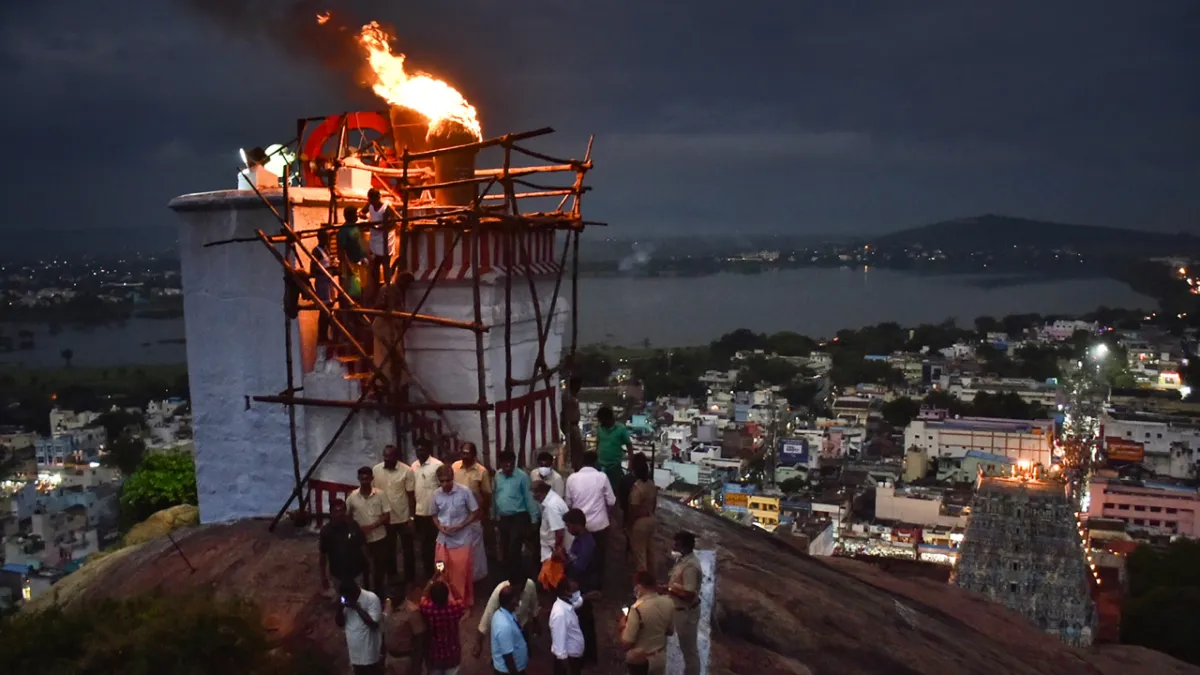
The Madras High Court has agreed to urgently hear a batch of petitions challenging the prohibitory orders imposed across Madurai district in connection with the ongoing controversy over the lighting of the traditional Karthigai Deepam at Thiruparankundram hill.
A Division Bench comprising Justice G.R. Swaminathan and Justice M.D. Sumathi is scheduled to hear the matters at 12:30 PM on November 24. According to reports, the Court has also summoned the Madurai District Collector and the Commissioner of Police to appear before it.
The petitions have been filed against the prohibitory orders issued under Section 163 of the Bharatiya Nagarik Suraksha Sanhita (BNSS), which restrict public gatherings, demonstrations, processions and other activities in the district. The restrictions were imposed on November 23, shortly before the scheduled lighting of the ceremonial lamp on the occasion of Karthigai Deepam.
Challenge To Section 163 BNSS Restrictions
The petitioners have questioned the legality of the prohibitory orders, contending that the restrictions impede the implementation of the Supreme Court’s directions concerning the lighting of the Karthigai Deepam at the Deepathoon, a stone pillar situated atop Thiruparankundram hill.
The pleas seek directions to facilitate the lighting of the ceremonial lamp at the disputed location and ensure that devotees are permitted to witness the religious observance from the foothills.
The petitioners have also sought directions for the officials of the Hindu Religious and Charitable Endowments (HR&CE) Department and the Archaeology Department to be allowed to participate in the arrangements for lighting the lamp, with the assistance of Central Reserve Police Force (CRPF) personnel.
The challenge arises against the backdrop of the continuing dispute concerning the customary location for lighting the Karthigai Deepam. The controversy has attracted considerable public attention, with competing claims concerning religious practices, administrative authority and the maintenance of public order.
Supreme Court’s Interim Direction For November 24
The latest developments follow an interim order passed by the Supreme Court on November 20 in the ongoing Thiruparankundram Deepam dispute.
A Bench comprising Justice Aravind Kumar and Justice Vipul M. Pancholi stayed the relevant observations made in an earlier Madras High Court judgment concerning the lighting of the ceremonial lamp at the Deepathoon.
However, considering the proximity of the Karthigai Deepam festival and the fact that the occasion could not be recreated through a subsequent judicial determination, the Supreme Court permitted the lighting of the lamp at the Deepathoon on November 24 as a one-time arrangement.
The Supreme Court made it clear that the temporary permission should not be treated as a final determination of the alleged customary practice of lighting the lamp at the disputed location.
It further clarified that the interim arrangement would not establish any permanent religious right or customary entitlement for future years. The larger questions concerning the rights claimed by the parties were left open for consideration at an appropriate stage.
Restrictions Imposed On Public Access
While permitting the ceremonial lighting, the Supreme Court prescribed specific safeguards to ensure that the exercise was conducted peacefully.
The Court directed that access to the Deepathoon should be restricted to authorised representatives of the Devasthanam and government officials. Members of the general public would not be permitted to enter the location during the ceremony.
It also prohibited processions, public congregations, slogan-raising and demonstrations in connection with the ritual.
The District Collector was directed to coordinate with the Temple Executive Officer, the Archaeological Survey of India and the Madurai Commissioner of Police to finalise the composition of the authorised team and make the necessary arrangements. The Collector was also designated as the nodal officer for implementing the directions.
The authorities were further directed to ensure adequate security arrangements. The Supreme Court permitted the deployment of the Central Industrial Security Force (CISF), if considered necessary, and directed the District Collector to submit a compliance report within three days after the festival.
The Court also clarified that the religious activities of the nearby Dargah and mosque should not be disturbed during the implementation of the arrangement.
Madurai Administration Issues Prohibitory Orders
Meanwhile, Madurai District Collector and District Magistrate Nishant Krishna issued prohibitory orders under Section 163 BNSS on November 23, citing apprehensions of a law-and-order situation.
The restrictions were imposed following reports from the Madurai City Police Commissioner, the District Superintendent of Police and the Revenue Divisional Officer regarding the possibility of large-scale mobilisation by groups supporting and opposing the lighting of the lamp at the Deepathoon.
The administration expressed concerns that competing gatherings could lead to confrontations, disturbances and potential threats to public peace and tranquillity.
The prohibitory orders, however, specifically exempted activities undertaken in pursuance of or for giving effect to the Supreme Court’s November 20 directions.
The restrictions were scheduled to remain in force from 9 PM on November 23 until 10 AM on November 25, subject to the exemptions specified in the order.
High Court Hearing Assumes Significance
Against this background, the urgent hearing before the Madras High Court assumes considerable significance, particularly in view of the Supreme Court’s limited permission for the ceremonial lighting on November 24.
The petitioners’ challenge raises questions concerning the implementation of judicial directions, the scope of prohibitory powers under Section 163 BNSS and the balance between maintaining public order and facilitating religious observances.
The appearance of the Madurai District Collector and the Police Commissioner before the High Court is also expected to bring clarity regarding the administrative measures adopted to implement the Supreme Court’s interim directions.
The proceedings will be closely watched as the Court considers the challenge to the prohibitory orders amid the continuing Thiruparankundram Deepam controversy.
Further developments in the matter are awaited.
For more updates on the proceedings and other important legal developments, readers can visit The Legal Observer’s News Section.
The Legal Observer also provides legal news and discussions through its official YouTube channel.