
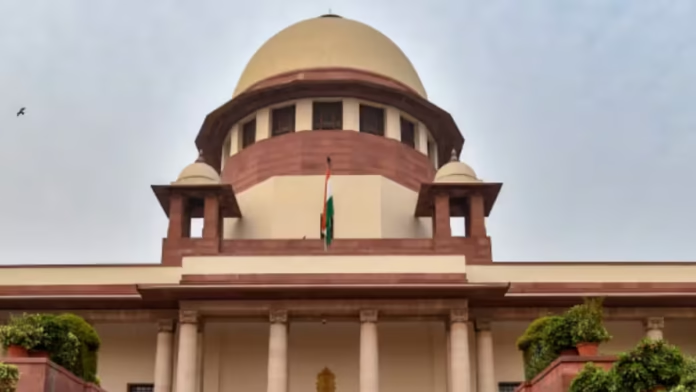
Supreme Court issues a contempt notice to advocate Pravin Singhal over insulting remarks against CJI Surya Kant during open court proceedings.
The Supreme Court has initiated criminal contempt proceedings against an advocate following allegedly insulting remarks directed at Chief Justice of India Surya Kant during open court proceedings.
The Supreme Court on November 18 issued a show-cause notice to Advocate Pravin Singhal over allegedly insulting and scandalous remarks made against Chief Justice of India (CJI) Surya Kant during open court proceedings on November 16. The proceedings follow a petition filed by the Supreme Court Bar Association (SCBA) seeking initiation of criminal contempt action against the advocate.
Supreme Court Bench Issues Notice
A three-judge Bench comprising Justice Dipankar Datta, Justice Joymalya Bagchi and Justice V. Mohana took up the criminal contempt petition filed by the Supreme Court Bar Association and issued a show-cause notice to Advocate Pravin Singhal, asking him to explain why contempt proceedings should not be initiated against him.
The matter arises from an incident that took place on November 16, when Singhal allegedly made personal and insulting remarks against CJI Surya Kant inside the Supreme Court courtroom. The incident reportedly occurred when the advocate approached a Bench comprising the Chief Justice and Justices Joymalya Bagchi and V. Mohana, seeking an urgent hearing in a matter.
According to reports, Singhal had earlier submitted certain documents before the CJI’s office on November 2 and complained that he had not received any response even after several days. When he raised the issue before the Bench and sought an immediate hearing, the Chief Justice asked him to wait.
However, the advocate allegedly refused to wait and made remarks questioning the Chief Justice’s suitability to occupy the constitutional office. He reportedly told the CJI that he could not sit in that chair, did not deserve the position and lacked integrity.
The remarks triggered an unusual situation inside the courtroom. Following the incident, the audio-video recording of the proceedings was reportedly switched off, and security personnel escorted the advocate out of the courtroom.
SCBA Seeks Criminal Contempt Proceedings
Taking serious note of the incident, the Supreme Court Bar Association decided to seek criminal contempt proceedings against the advocate.
On November 17, SCBA Secretary Pragya Baghel and Joint Secretary Meenesh Dubey mentioned the matter before the Chief Justice of India and informed the Court that the association had obtained the consent of Attorney General for India R. Venkataramani to initiate criminal contempt proceedings against Pravin Singhal.
The Attorney General, after considering the allegations and the material placed before him, granted consent for initiating criminal contempt proceedings. In his communication, he reportedly described the advocate’s conduct and remarks as “extremely scandalous and unpardonable”.
The consent was granted under Section 15(1)(b) of the Contempt of Courts Act, 1971, which provides for the initiation of criminal contempt proceedings on a motion made by a person with the consent of the Attorney General or Solicitor General.
The SCBA also informed the Court that it possessed video recordings allegedly showing the advocate making similar remarks against the Chief Justice on earlier occasions.
During the mentioning, the association’s office-bearers had also requested that the fresh contempt petition be tagged with an earlier petition filed by the SCBA seeking contempt action against journalist Nikhil Wagle and Shiv Sena (UBT) leader Sanjay Raut over their remarks concerning the CJI and the judiciary.
Understanding Criminal Contempt Under Indian Law
The Contempt of Courts Act, 1971, defines criminal contempt under Section 2(c). It broadly includes the publication or commission of any act that scandalises or tends to scandalise, lowers or tends to lower the authority of any court, prejudices or interferes with judicial proceedings, or obstructs the administration of justice in any other manner.
The purpose of contempt jurisdiction is to protect the authority and dignity of judicial institutions and ensure that the administration of justice remains free from interference or obstruction.
At the same time, the power is required to be exercised carefully, keeping in mind the constitutional protection of freedom of speech and expression under Article 19(1)(a). Criticism of judicial decisions and the functioning of courts, when expressed fairly and within lawful limits, is an essential part of a democratic system.
However, allegations or personal attacks that allegedly undermine the authority of the judiciary may attract scrutiny under the law of contempt, depending on the circumstances and the material before the Court.
Section 15 of the Contempt of Courts Act provides the procedure for taking cognisance of criminal contempt in certain circumstances. The requirement of consent from the Attorney General or Solicitor General in cases initiated through a private motion serves as an important procedural safeguard against frivolous or motivated contempt proceedings.
Proceedings To Continue Before Supreme Court
With the issuance of the show-cause notice, Advocate Pravin Singhal will have an opportunity to place his explanation before the Supreme Court regarding the allegations made against him.
The Court will consider his response and determine whether the alleged conduct warrants further criminal contempt proceedings under the applicable legal framework.
The development once again brings into focus the delicate balance between freedom of expression, the right to criticise judicial institutions and the responsibility to maintain the dignity and authority of the courts.
The matter is significant as it concerns conduct allegedly displayed inside the courtroom, where advocates are expected to maintain professional discipline and uphold the standards of the legal profession.
The Supreme Court’s further consideration of the matter will determine how the allegations are dealt with in accordance with the Contempt of Courts Act, 1971.
For more updates on significant Supreme Court developments and legal proceedings, visit The Legal Observer’s National News section and watch its legal updates on the The Legal Observer YouTube channel.