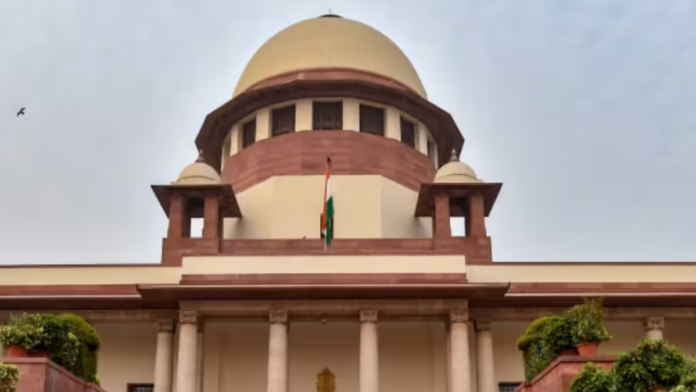
The Supreme Court flags poor sanitation and weak solid waste management, observing that India’s economic growth is being undermined by inadequate implementation of SWM Rules 2026.
Expressing serious concern over the inadequate implementation of the Solid Waste Management Rules, 2026, the Supreme Court has observed that India’s economic progress is being undermined by poor sanitation and the failure of authorities to effectively manage solid waste.
Supreme Court Flags Poor Implementation Of Solid Waste Management Rules
The Supreme Court has strongly criticised the inadequate implementation of the Solid Waste Management (SWM) Rules, 2026, across States and local bodies, observing that poor sanitation is undermining India’s economic achievements. The Court emphasised that despite the country’s economic growth and availability of resources, the failure of authorities and citizens to ensure proper waste management continues to affect public health, environmental protection and the country’s overall development.
A Bench of Justice S.V.N. Bhatti and Justice N.V. Anjaria made these observations on November 17 while examining the progress report submitted by the Supreme Court Monitoring Committee (SCMC) in the matter concerning the implementation of the SWM Rules, 2026.
The Bench remarked that India had achieved considerable economic progress but continued to perform poorly in sanitation. The Court observed that the benefits of growth in other sectors were being negated by the collective failure of stakeholders to address the problem of inadequate sanitation and solid waste management.
The Court further emphasised that poor sanitation affects the overall image and development of society and the country. Referring to the progress made by similarly placed economies, both within India and internationally, the Bench observed that achieving sanitation and hygiene objectives was possible with the resources already available. However, it required consistent enforcement by statutory authorities and responsible participation from citizens.
Court Directs District Collectors To Conduct Drone Surveys
While examining the SCMC’s progress report, the Supreme Court identified several deficiencies in the implementation mechanism and directed District Collectors across the country to undertake drone surveys and video-call inspections to assess the actual condition of waste management facilities.
The Bench directed Chief Secretaries of all States to ensure that District Collectors upload geotagged and timestamped photographs showing the condition of facilities in Urban Local Bodies (ULBs) and Rural Local Bodies (RLBs) as of November 21, 2026. They must also submit photographs reflecting the progress made by January 1, 2027.
The SCMC has been directed to compile the information and place a district-wise status report before the Court, based on verifiable parameters.
The District Collectors have also been asked to submit category-wise information concerning private establishments and identified Bulk Waste Generators (BWGs), including details of deficiencies detected and action taken against establishments violating the SWM Rules, 2026.
Significant Gaps In Implementation Identified
The Supreme Court expressed concern over the inadequate progress made by several States and districts in establishing the required administrative infrastructure.
The Bench noted that approximately 400 districts were yet to establish Special Cells to assist District Collectors in implementing the waste management rules.
It further highlighted that only nine out of 28 States had achieved the prescribed target concerning urban bylaws. Additionally, 16 States had not reported the incorporation of rural bylaws, while 18 States had failed to provide information regarding four-way segregation of solid waste in rural areas.
The Court also expressed dissatisfaction over the absence of adequate information regarding notices issued to residential, commercial and business establishments for non-compliance with waste management requirements.
Further deficiencies included inadequate reporting on public-private participation, corporate social responsibility (CSR) contributions and initiatives concerning biogas and waste-to-energy facilities.
Railways Also Asked To Ensure Compliance
The Supreme Court separately expressed concern over the inadequate compliance demonstrated by the Indian Railways.
The Bench noted that only 630 out of 8,809 railway stations had been mapped to local bodies, while merely 510 railway premises were following the prescribed four-way waste segregation system.
Considering the extent of non-compliance, the Court directed the Railways to ensure complete implementation of the applicable requirements within eight weeks.
The Court also emphasised the importance of educating children and encouraging their participation in maintaining sanitation and environmental hygiene. It directed the Education Departments of the States to comply with its earlier orders without further delay.
Local Bodies Cannot Cite Financial Constraints
Referring to its earlier judgment in Municipal Council, Ratlam v. Shri Vardhichand (1980), the Supreme Court reiterated that municipalities cannot avoid their statutory responsibility to maintain public health, sanitation and hygienic living conditions by citing financial difficulties.
The Bench observed that the principle laid down decades ago continues to remain relevant. Local authorities are expected to discharge their statutory responsibilities and cannot use financial limitations as an excuse for failing to address sanitation-related problems.
The Court also stressed that industries should utilise their CSR contributions towards strengthening solid waste management infrastructure in the local areas where they operate. It highlighted the importance of developing compressed biogas plants and waste-to-energy facilities to improve waste processing.
Continuing Monitoring By Supreme Court
The Bench observed that although Parliament had enacted the Environment (Protection) Act, 1986, and the Executive had framed the SWM Rules, 2026, their implementation remained substantially below the intended standards.
Emphasising the constitutional right to a pollution-free environment, the Court stated that it was continuing its monitoring through the SCMC to ensure that local bodies and other stakeholders fulfilled their responsibilities.
The matter has been listed for further hearing on January 12, 2027.
The Supreme Court’s observations underline that economic development cannot be considered complete without adequate sanitation, environmental protection and effective waste management. The Court has made it clear that statutory authorities, industries, local bodies and citizens must work collectively to ensure that the country’s economic progress is reflected in improved public hygiene and environmental conditions.
For further updates on important environmental law developments and Supreme Court decisions, readers can visit The Legal Observer and its official YouTube channel.