
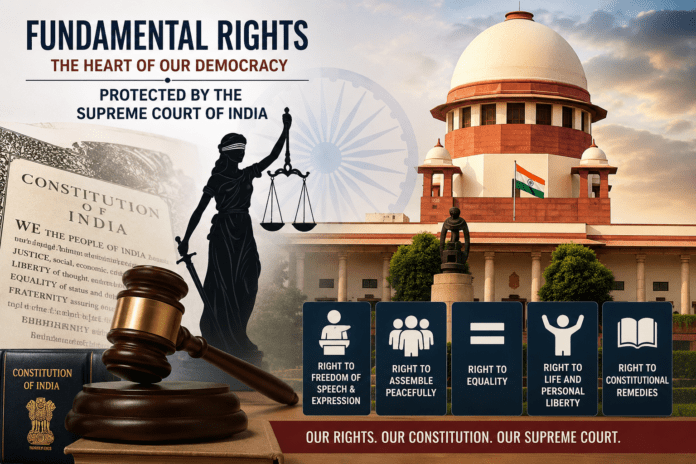
A closer look at the role of constitutional courts in protecting fundamental rights, liberty and democratic freedoms in India.
Recent events surrounding protests at Jantar Mantar and the subsequent police action have renewed the debate over the constitutional responsibility of courts to protect citizens’ fundamental rights.
India is the world’s largest democracy, and at the heart of its democratic structure lies the Constitution. It is not merely a legal document but the foundation upon which the country’s system of governance operates. Its central objectives include Justice, Liberty, Equality and Fraternity, values that are intended to guide both the State and its institutions.
Recent protests by young Indians at Jantar Mantar, followed by allegations of excessive police action and the subsequent intervention of the Supreme Court, have once again brought the protection of fundamental rights into public focus. The developments raise an important question: Are constitutional courts doing enough to protect citizens when their fundamental freedoms are allegedly threatened?
Constitution And The Three Pillars Of Democracy
The Constitution was framed after extensive deliberations by the Constituent Assembly, which began its work on December 9, 1946, and completed the Constitution on November 25, 1949. The Assembly devoted considerable time to debating and refining the country’s foundational legal framework.
The constitutional scheme distributes governmental power among three principal institutions — the Executive, Legislature and Judiciary.
The Executive is responsible for administering the country, while the Legislature makes laws. The Judiciary, particularly the constitutional courts, performs the crucial function of reviewing governmental action and ensuring that constitutional limitations are respected.
This system of checks and balances is essential to a functioning democracy.
Fundamental Rights As Constitutional Guarantees
Fundamental Rights occupy a central position in the Indian constitutional framework. They protect individuals against arbitrary State action and provide citizens with legally enforceable guarantees concerning liberty, equality and other essential freedoms.
The right to freedom of speech and expression, the right to assemble peacefully and the right to life and personal liberty are among the constitutional protections that frequently arise when demonstrations or public protests are involved.
A democratic government is expected to maintain public order, but such responsibility must operate within constitutional boundaries. The existence of a legitimate governmental objective does not automatically eliminate the rights of citizens.
The difficult question is therefore one of balance: how should authorities maintain public order while ensuring that legitimate dissent is not unnecessarily restricted?
Role Of The Supreme Court And High Courts
The Supreme Court and High Courts have been entrusted with significant constitutional powers to protect fundamental rights. Through judicial review, courts can examine whether executive action is consistent with constitutional guarantees.
Article 32 empowers citizens to approach the Supreme Court for enforcement of Fundamental Rights, while Article 226 gives High Courts broad powers to issue writs for the enforcement of fundamental rights and for other legal purposes.
These provisions demonstrate the Constitution’s intention that the Judiciary should remain accessible when citizens allege violations of their rights.
The recent Jantar Mantar developments have therefore renewed discussion about whether constitutional courts should respond swiftly whenever allegations of disproportionate State action arise.
Judicial Intervention And Democratic Accountability
Judicial intervention does not necessarily mean that courts should substitute themselves for the Executive. Rather, the constitutional role of the Judiciary is to ensure that governmental power is exercised according to law.
When questions arise concerning police conduct, restrictions on peaceful assembly or alleged violations of personal liberty, judicial scrutiny can serve as an important safeguard.
At the same time, allegations made by any side must ultimately be tested against evidence and the applicable law. Constitutional protection is strongest when courts remain independent, impartial and guided by established legal principles rather than public pressure.
The Larger Democratic Question
The debate surrounding the Jantar Mantar protests goes beyond one particular incident. It raises a larger question about the relationship between citizens and institutions in a constitutional democracy.
Fundamental rights have meaning only when they can be effectively enforced. Equally, governmental authority must be capable of functioning within the limits prescribed by the Constitution.
The Judiciary therefore occupies a unique position. It is not merely another governmental institution; it is also a constitutional check on the exercise of State power.
Ultimately, the strength of Indian democracy will depend not only on the laws enacted by Parliament or the policies implemented by governments but also on the ability of constitutional institutions to ensure that Justice, Liberty, Equality and Fraternity remain living constitutional values.
The question of whether our constitutional courts are adequately protecting fundamental rights deserves continued public discussion, careful judicial scrutiny and, above all, a commitment to the constitutional principles on which the Republic was founded.
For more legal developments and opinion pieces, readers can explore [The Legal Observer’s views and insights] and its broader [national news coverage]. Video updates and legal discussions are also available on [The Legal Observer’s YouTube channel]The Legal Observer YouTube Channel.