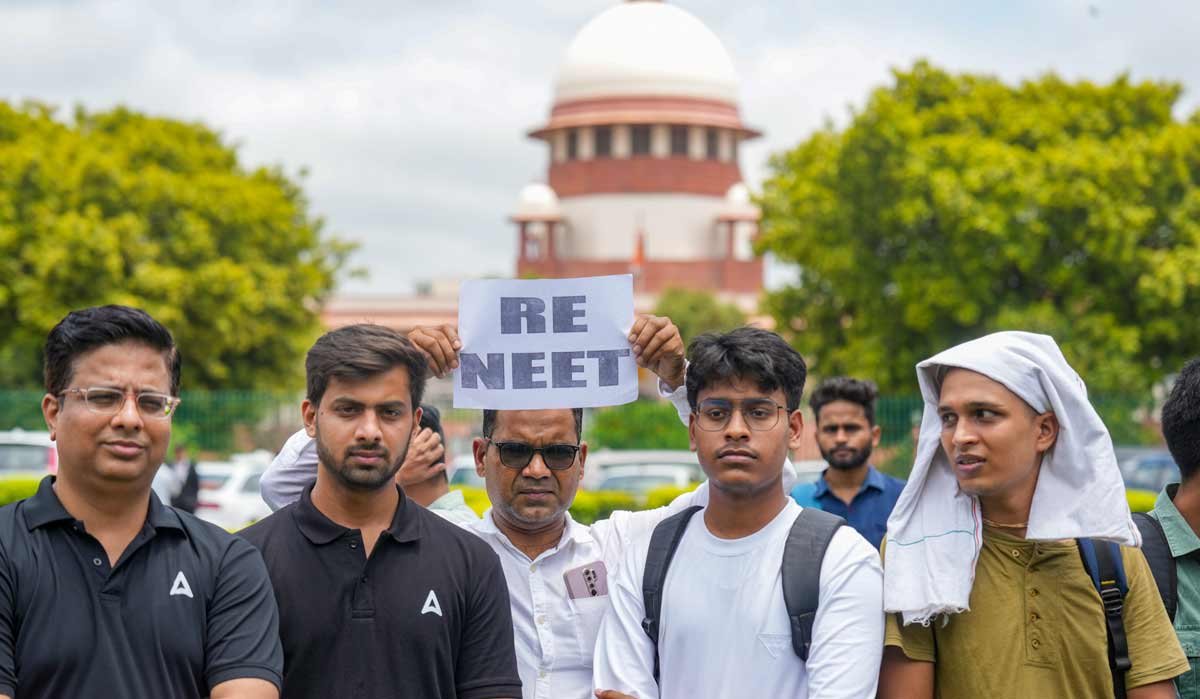
The Supreme Court declined to hear a plea by six NEET UG 2026 candidates over alleged OMR sheet discrepancies and directed them to approach the Delhi High Court.
Supreme Court Says OMR Grievances Can Be Raised Before Delhi High Court
The Supreme Court on Friday declined to entertain a writ petition filed by six candidates of the NEET UG 2026 examination who alleged discrepancies between the answers they had originally marked on their Optical Mark Recognition (OMR) sheets and the copies of the OMR sheets later made available by the National Testing Agency (NTA) after the declaration of the re-examination results.
While disposing of the petition, the apex court granted the students liberty to approach the Delhi High Court for appropriate relief. The Bench observed that it was not inclined to examine the matter in its writ jurisdiction, particularly since the NEET UG 2026 re-examination had already been conducted and broader issues relating to institutional reforms within the National Testing Agency are already pending consideration before the Supreme Court.
The petitioners had approached the Court alleging that the OMR sheets uploaded by the NTA after the re-examination did not accurately reflect the answers they had originally marked during the examination. According to the students, they sought access to their original OMR records to verify the evaluation process and ensure that the marks awarded were based on the answers actually recorded during the test.
Appearing on behalf of the petitioners, Advocate Sanjeev Malhotra clarified that the candidates were not seeking to interfere with or stall the ongoing NEET UG counselling process. Instead, he submitted that the students had made a limited request for access to their OMR sheets so that they could independently verify the correctness of the evaluation.
The submission sought to distinguish the present petition from challenges that could potentially disrupt the admission process. Counsel argued that the petitioners were merely seeking transparency regarding the examination records and were not asking for the counselling schedule to be stayed or modified.
After considering the submissions, the Supreme Court declined to entertain the petition. The Bench observed that the grievances raised by the candidates could appropriately be pursued before the Delhi High Court, while also noting that the larger questions concerning reforms in the functioning of the NTA are already sub judice before the apex court.
The Court’s order effectively leaves it open to the petitioners to seek appropriate judicial remedies before the Delhi High Court without expressing any opinion on the merits of their allegations. The Supreme Court did not examine whether any discrepancy actually existed between the candidates’ original responses and the OMR sheets made available by the NTA.
The case highlights the continuing scrutiny surrounding the conduct of national entrance examinations and the demand for greater transparency in the evaluation process. OMR sheets play a crucial role in determining candidates’ scores, and any alleged mismatch between recorded answers and published copies can have significant consequences for students competing for limited medical seats.
The National Eligibility-cum-Entrance Test (NEET UG) remains the country’s largest medical entrance examination, with lakhs of aspirants competing annually for admission to undergraduate medical and dental courses. Given the scale of the examination, issues relating to evaluation, answer keys and transparency frequently become the subject of judicial review.
Legal experts note that courts generally refrain from intervening in examination processes unless there is a clear violation of statutory provisions, arbitrariness or procedural irregularity. At the same time, judicial oversight continues to serve as an important safeguard to ensure fairness and accountability in public examinations.
The Supreme Court’s decision also reflects the principle that High Courts are often the appropriate forum to examine individual grievances involving examination authorities, particularly where factual disputes require detailed scrutiny. By granting liberty to approach the Delhi High Court, the Bench ensured that the petitioners retain an effective legal remedy while allowing the ongoing admission process to proceed without interruption.
The matter is now expected to move before the Delhi High Court, where the petitioners may seek directions regarding access to their original OMR sheets and any other relief considered appropriate under law.
Readers can stay updated on significant judicial developments through the News section at https://thelegalobserver.com/category/news/ and explore expert legal analysis in the Insight section at https://thelegalobserver.com/category/views/insight/. For video explainers on important legal issues, visit The Legal Observer’s YouTube channel: https://www.youtube.com/@thelegalobserver.