
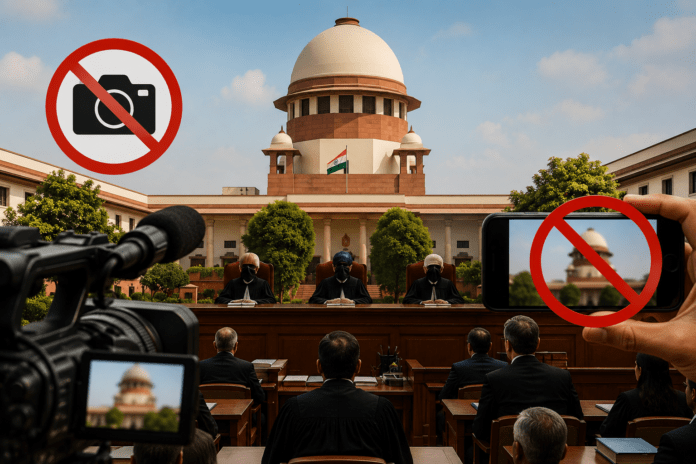
In a significant ruling aimed at preserving the sanctity of judicial proceedings, the Supreme Court has prohibited the recording, reproduction, and circulation of videos from court proceedings without authorization. The Court observed that once such recordings are released into the public domain, they can be easily manipulated, taken out of context, or widely circulated, making it difficult to control their misuse. Referring to the situation, the Bench remarked that “the demon is out of the bag,” highlighting the irreversible consequences of unauthorized dissemination of courtroom footage.
The ruling comes amid growing concerns over the misuse of videos from live-streamed court proceedings on social media platforms. The Court noted that edited clips, selective excerpts, and sensationalized content can distort judicial discussions, mislead the public, and undermine the dignity of the justice delivery system.
While imposing restrictions on recording and sharing courtroom videos, the Supreme Court made it clear that the order does not amount to a gag on the media. The Bench specifically clarified that accredited journalists and news organizations remain free to report on court proceedings in accordance with established legal and ethical standards. The restriction applies only to the unauthorized recording, reproduction, and circulation of audiovisual content from court proceedings.
The Court emphasized that live-streaming of proceedings was introduced to enhance transparency and improve public access to the justice system. However, it observed that this objective should not be compromised by misuse of video recordings for entertainment, misinformation, political narratives, or commercial purposes. The judges noted that courtroom discussions often involve complex legal arguments that can be misunderstood when presented through short or edited video clips.
The Supreme Court also highlighted the need to strike a balance between the principle of open justice and the responsibility to protect the integrity of judicial proceedings. It observed that unrestricted circulation of courtroom videos could influence public opinion, affect pending cases, and expose participants in judicial proceedings to unnecessary scrutiny or harassment.
Legal experts believe the ruling establishes important safeguards for the responsible use of live-streamed court proceedings while preserving transparency in the judicial process. By distinguishing between legitimate news reporting and the unauthorized circulation of audiovisual content, the Court has attempted to prevent misuse without limiting the media’s role in informing the public.
The decision is expected to guide future policies governing live-streaming of court proceedings and reinforce the principle that judicial transparency must be accompanied by accountability in the use of courtroom content. At the same time, the Supreme Court’s clarification ensures that the press can continue reporting on important legal developments without facing restrictions under the new order.