
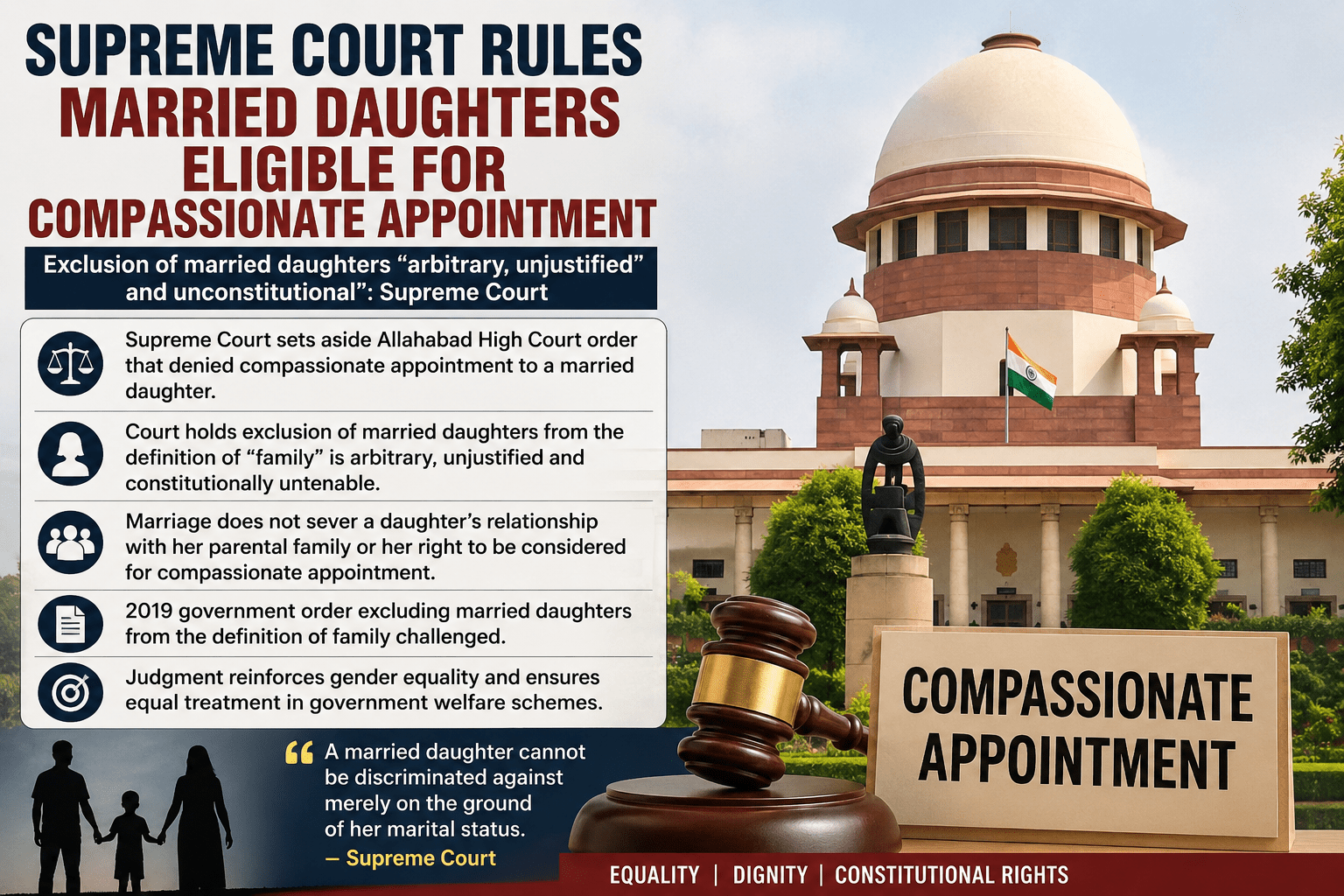
In a significant judgment advancing gender equality, the Supreme Court has ruled that married daughters cannot be denied consideration for compassionate appointment solely on the ground of their marital status. The Court held that excluding married daughters from the definition of “family” is discriminatory, arbitrary, and contrary to constitutional principles.
A bench comprising Justice P.S. Narasimha and Justice Alok Aradhe made the observation while setting aside an order of the Allahabad High Court that had denied compassionate appointment to a married daughter.
Background of the Case
The case arose from an appeal filed by a woman whose father, a fair price shop dealer, had passed away. After his death, she sought appointment on compassionate grounds. However, her claim was rejected because a 2019 government order excluded married daughters from the definition of “family” for the purpose of compassionate appointments.
The woman challenged both the government order and the subsequent High Court ruling, arguing that marital status could not be a valid basis for denying her eligibility.
Supreme Court’s Observations
The Supreme Court agreed with the appellant’s contention and held that the exclusion of married daughters lacked any reasonable justification. The bench observed that marriage does not sever a daughter’s relationship with her parental family, nor does it automatically extinguish her financial dependence or responsibilities toward the family.
The Court emphasized that constitutional guarantees of equality prohibit discrimination based solely on gender or marital status. It noted that treating married sons and married daughters differently for compassionate appointments perpetuates outdated stereotypes and fails to reflect contemporary social realities.
According to the bench, the omission of married daughters from the definition of family was “manifestly arbitrary, unjustified and constitutionally untenable.”
Significance of Compassionate Appointment
Compassionate appointment is a welfare measure intended to provide immediate financial relief to the family of a government employee or eligible public servant who dies while in service or is forced to retire prematurely due to medical incapacity. The objective is to prevent the family from falling into financial distress following the loss of its primary breadwinner.
The Court observed that eligibility for such appointments should be determined by the purpose of the scheme and the actual circumstances of the family rather than rigid assumptions based on marital status.
Impact of the Judgment
The ruling is expected to have far-reaching implications for government policies and service rules across various states that continue to exclude married daughters from compassionate appointment schemes or similar welfare benefits.
By recognizing married daughters as part of the family for such purposes, the Supreme Court has reinforced the constitutional principles of equality and non-discrimination, ensuring that women are not disadvantaged merely because they are married.
Key Takeaway
The Supreme Court has made it clear that a married daughter’s right to be considered for compassionate appointment cannot be denied solely due to her marriage. The judgment strengthens gender equality in public employment policies and removes a long-standing barrier that treated married daughters differently from other family members.