
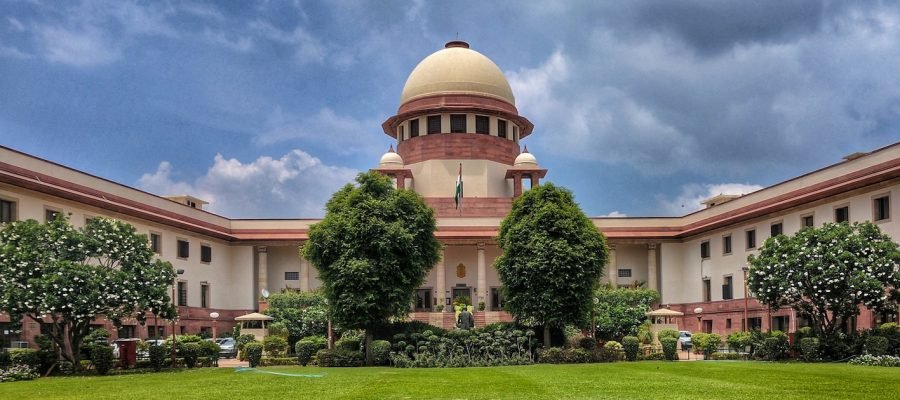
Supreme Court examines compassionate appointment under NCWA where the dependent crossed the prescribed age of 35 years.
The Supreme Court has considered whether a dependent who was below the prescribed age limit when the employee died can be denied compassionate appointment merely because the claim was considered later.
The Supreme Court has examined the claim of compassionate appointment made by the son of a deceased employee of Western Coalfields Limited, after his request was rejected on the ground that he had crossed the prescribed upper age limit of 35 years by the time his claim was considered.
The appeal, Raspelli Bhagya Kistaiya & Ors. v. General Manager, Western Coalfields Limited & Ors., arose from a judgment of the Bombay High Court, Nagpur Bench, which had upheld the rejection of the compassionate appointment claim. The matter is registered as SLP(C) No. 7244/2026 before the Supreme Court.
Employee Died After Nearly 36 Years Of Service
The case concerns Late Ruspelli Kistaiya, who had served Western Coalfields Limited as a Dozer Operator for nearly 36 years. He died in harness on December 17, 2020.
His son, appellant No. 2, was 34 years, 10 months and 12 days old on the date of his father’s death. His date of birth was February 5, 1986.
The significance of this calculation lies in the National Coal Wage Agreement-VI (NCWA-VI), under which compassionate appointment is governed by prescribed conditions, including an upper age limit of 35 years under Clause 9.3.4.
According to the judgment, the dependent was therefore below the prescribed age of 35 years when his father’s death occurred.
The dispute arose because the claim for compassionate appointment was considered at a later stage, by which time the dependent had crossed the age of 35 years.
Western Coalfields Issued SOP For Compassionate Appointment
After the employee’s death, Western Coalfields Limited issued a Standard Operating Procedure/Circular on December 31, 2020, laying down the procedure for onboarding dependants of ex-employees on compassionate grounds.
The appellants relied upon the circumstances surrounding the consideration of the claim and contended that the relevant date for determining eligibility should not be mechanically shifted to the date on which the employer eventually considered the application.
The issue consequently raised an important question concerning the application of age restrictions in compassionate appointment cases.
For readers following developments concerning employment law and public-sector service matters, The Legal Observer’s National News section provides further coverage.
Bombay High Court Rejected The Claim
The appellants had challenged the rejection of the compassionate appointment claim before the Bombay High Court, Nagpur Bench.
However, by its judgment dated November 26, 2025, the High Court dismissed the writ petition. The principal reason was that appellant No. 2 had crossed the age of 35 years prescribed under Clause 9.3.4 of NCWA-VI by the time his claim came to be considered.
Aggrieved by this decision, the appellants approached the Supreme Court.
The Supreme Court granted leave in the matter. The case was thereafter registered as SLP(C) No. 7244/2026. The Court’s cause lists record the matter as Raspelli Bhagya Kistaiya and Ors. v. General Manager, Western Coalfields Limited and Ors.
What Is Compassionate Appointment?
Compassionate appointment is intended to provide immediate assistance to the family of an employee who dies while in service, subject to the governing service rules or applicable scheme.
It is not ordinarily treated as a regular mode of recruitment. Rather, its purpose is to provide relief to a family facing financial hardship following the death of its earning member.
Consequently, eligibility conditions contained in the applicable scheme assume considerable importance.
In the present case, the dispute centres on the interaction between the objective of compassionate appointment and the age restriction prescribed under the NCWA.
The appellants’ case is particularly significant because the dependent was only a few months short of 35 when his father died. The subsequent passage of time resulted in him crossing the prescribed age before the employer considered his claim.
Importance Of The Supreme Court Proceedings
The case raises a broader question about whether eligibility for compassionate appointment should be assessed with reference to the date on which the employee died or the date on which the employer actually considered the dependent’s claim.
This distinction can have substantial consequences. A dependent who satisfies the age requirement immediately after the employee’s death could become ineligible merely because administrative consideration of the application takes place later.
At the same time, compassionate appointment remains governed by the applicable service scheme, and courts are required to examine the precise language of the governing provisions.
The Supreme Court’s consideration of the matter is therefore significant for employees of coal companies covered by the NCWA and their dependants seeking appointment on compassionate grounds.
The case also highlights the importance of timely processing of compassionate appointment claims, since delays in consideration can potentially affect the eligibility of dependants where the governing scheme contains an upper age limit.
For more legal updates and developments, readers can visit The Legal Observer and follow its News section.
The matter was listed before the Supreme Court as an admission-stage civil proceeding, with SLP(C) No. 7244/2026 arising from the Bombay High Court judgment. The official Supreme Court cause lists also record the appearance of counsel for the appellants and respondents.