Supreme Court reserves verdict in Delhi riots conspiracy bail pleas; Delhi Police cites Sharjeel Imam’s speech as evidence. | The Legal Observer
The Supreme Court has reserved its verdict on the bail pleas filed by six accused in the 2020 Delhi riots larger conspiracy case, after extensive arguments on evidentiary links, conspiracy principles, and the role of speeches in criminal attribution.
Supreme Court Concludes Hearing in High-Profile Bail Petitions
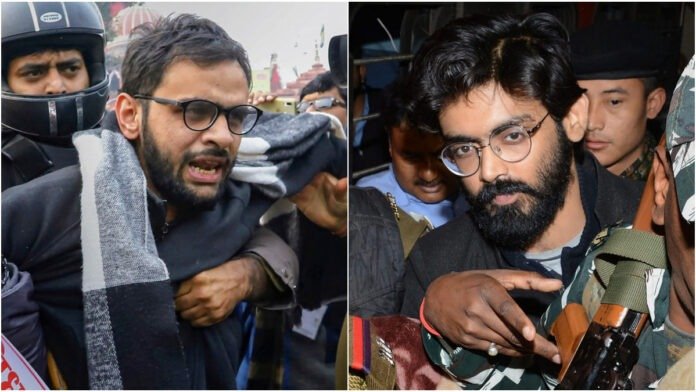
The Supreme Court on Wednesday reserved its judgment on the bail pleas of six individuals accused in the Delhi riots larger conspiracy case. The petitioners include Umar Khalid, Sharjeel Imam, Gulfisha Fatima, Meeran Haider, Shadab Ahmed, and Mohd Saleem Khan, all charged under provisions of the Unlawful Activities (Prevention) Act (UAPA), the Indian Penal Code (IPC), and various sections of the Code of Criminal Procedure (CrPC).
A Bench comprising Justice Aravind Kumar and Justice NV Anjaria heard the matter and stated that the verdict would be delivered before the Supreme Court closes for the winter recess on December 19.
Readers wishing to follow similar major court developments can visit the National News coverage at https://thelegalobserver.com/category/news/national/.
Delhi Police Argues That Acts of One Conspirator Extend to All
During submissions, ASG SV Raju, representing the Delhi Police, argued that the principle of conspiracy under criminal law allows the actions of one accused to be used as evidence against co-accused.
While paraphrasing the State’s contention, the ASG maintained that the speeches delivered by Sharjeel Imam could be treated as relevant evidence against the other accused, including Umar Khalid, because all alleged acts form part of a common design. He asserted that the alleged conspiracy involved coordinated mobilisation, incendiary rhetoric, and activities that preceded the riots, and therefore Imam’s speeches must be assessed in that interconnected context.
This contention draws from Sections 120A and 120B of the IPC, which define conspiracy and its evidentiary implications. Under UAPA’s stringent bail standard, courts must evaluate whether accusations appear prima facie true before granting bail.
For more legal interpretations and expert insights, readers can explore the Insight section at https://thelegalobserver.com/category/views/insight/.
Bench Questions Relevance of 2016 FIR in a 2020 Riots Case
An important portion of the hearing involved the Bench questioning the Delhi Police for relying on a 2016 FIR registered at JNU involving the alleged raising of “tukde-tukde” slogans. The Court asked how such an FIR could be connected to events that took place four years later during the 2020 riots.
The Bench observed—through paraphrased remarks—that prior FIRs must have a clear logical nexus with the events in question, failing which their evidentiary value becomes questionable. The judges reiterated that relevant evidence under the Evidence Act must establish proximity to the alleged conspiracy period unless the prosecution demonstrates continuing links or connected intent.
This scrutiny reflects the judiciary’s consistent approach in distinguishing background material from substantive incriminating evidence under UAPA’s strict framework.
More updates on judicial scrutiny in major cases are available in The Legal Observer’s news feed at https://thelegalobserver.com/category/news/.
Context: Understanding the Delhi Riots Larger Conspiracy Case
The 2020 Delhi riots conspiracy case alleges a coordinated effort behind protests against the Citizenship (Amendment) Act (CAA). The prosecution claims that various student activists and protest organisers had orchestrated a deliberate plan that escalated into violence. The accused have consistently denied these allegations, stating that they were involved in peaceful demonstrations.
The bail petitions before the Supreme Court challenge the High Court’s earlier refusal to grant bail, arguing that the evidence is largely composed of speeches, protest organisation activities, and electronic communications that do not amount to terrorism or violent conspiracy under UAPA.
This case has drawn national attention due to its intersection with free speech, student activism, and anti-CAA protests, forming a sensitive political backdrop. The Court, however, emphasised that the present proceedings would remain confined to legal parameters governing bail under UAPA and not the broader political narrative.
To explore more widely-read analyses, visit the Most Popular section at https://thelegalobserver.com/category/most-popular/.
Verdict Expected Before December 19 Winter Break
After hearing arguments from both sides, the Bench stated that the verdict would be delivered shortly. The Court underscored that the adjudication would rest on statutory interpretation, evidentiary thresholds, and the seriousness of the allegations, especially given the heightened threshold for bail in UAPA cases.
For video summaries and case explainers, readers can also visit The Legal Observer’s official YouTube channel at https://www.youtube.com/@thelegalobserver.
For legal assistance or further inquiry, readers may refer to the Legal Helpline page at https://thelegalobserver.com/category/legal-helpline/.