
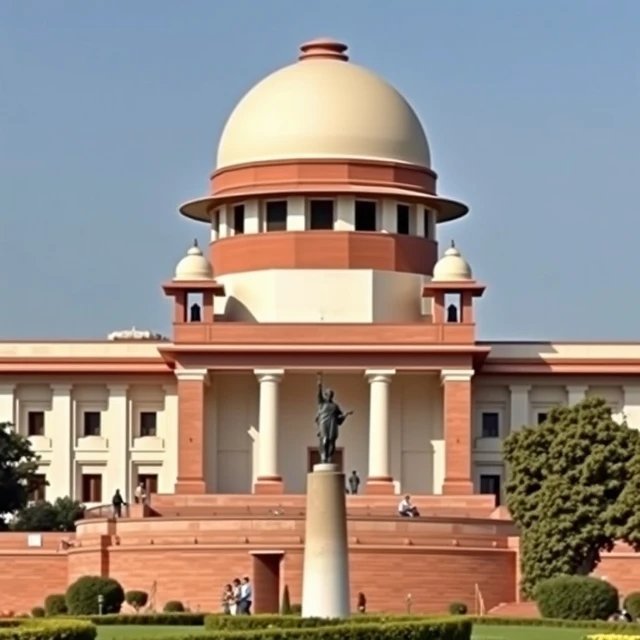
The Supreme Court observed that judicial officers are not government servants and may have a different retirement age. Read the latest judicial retirement age update.
Judicial Independence Takes Centre Stage as Supreme Court Examines Retirement Age Proposal
The Supreme Court has observed that judicial officers cannot be equated with government servants, underlining that members of the judiciary form a distinct and separate class. The significant observation came during the hearing of a matter concerning the proposal to enhance the retirement age of District Judges from 60 years to 62 years, a move that has sparked discussions on judicial reforms and the functioning of the subordinate judiciary.
The observations were made on Wednesday by a Bench comprising Chief Justice of India Surya Kant, Justice Joymalya Bagchi and Justice V. Mohan while considering objections raised against the proposal to increase the retirement age of District Judges.
The Bench made it clear that judicial officers perform constitutional responsibilities that are fundamentally different from those discharged by executive government employees. While government servants function within the executive framework, judicial officers exercise judicial powers independently and are entrusted with administering justice without external influence.
The Court observed that the judiciary occupies a unique constitutional position and, therefore, cannot automatically be subjected to the same service conditions applicable to government employees. According to the Bench, judicial officers constitute a separate class, making it legally permissible for their retirement age to differ from that of other public servants.
The proceedings revolved around one of the objections raised against increasing the retirement age of District Judges. The objection questioned whether judicial officers could be treated differently from other categories of government employees in matters relating to service conditions.
Responding to this concern, the Bench indicated that the distinction between judicial officers and government servants is rooted in the constitutional scheme itself. The independence of the judiciary, which forms part of the Constitution’s basic structure, requires that judicial officers be viewed through a different legal and institutional lens.
The proposal to increase the retirement age of District Judges has been discussed in the context of strengthening the justice delivery system. Supporters argue that allowing experienced judicial officers to continue in service for an additional two years would help address vacancies, reduce the loss of experienced judges and contribute to faster disposal of pending cases across district courts.
India’s district judiciary handles the overwhelming majority of litigation filed across the country. With courts facing significant backlogs and vacancies in judicial posts, retaining experienced judges for a longer period is viewed by many as a measure that could improve efficiency while maintaining continuity in judicial administration.
At the same time, the issue also raises broader questions about judicial service conditions, recruitment, promotions and institutional reforms. Any decision regarding retirement age would need to balance administrative efficiency with opportunities for younger judicial officers to progress through the ranks.
The Supreme Court’s remarks do not amount to a final ruling on increasing the retirement age. Instead, they clarify the constitutional position that judicial officers occupy a separate category from government servants, thereby leaving room for differentiated service conditions if considered appropriate under law.
Legal experts believe the Court’s observations reaffirm the long-standing principle that judicial independence extends beyond decision-making and also encompasses service conditions that preserve the autonomy and dignity of the judiciary.
The matter is expected to continue before the Supreme Court, where the Bench will examine the objections and policy considerations before arriving at an appropriate decision. The outcome could have far-reaching implications for judicial administration across the country and may influence future reforms relating to the subordinate judiciary.
Readers can explore more legal developments on The Legal Observer’s News section (https://thelegalobserver.com/category/news/) and legal analysis in the Insights section (https://thelegalobserver.com/category/views/insight/). For official video updates, visit The Legal Observer’s YouTube channel: https://www.youtube.com/@thelegalobserver.