
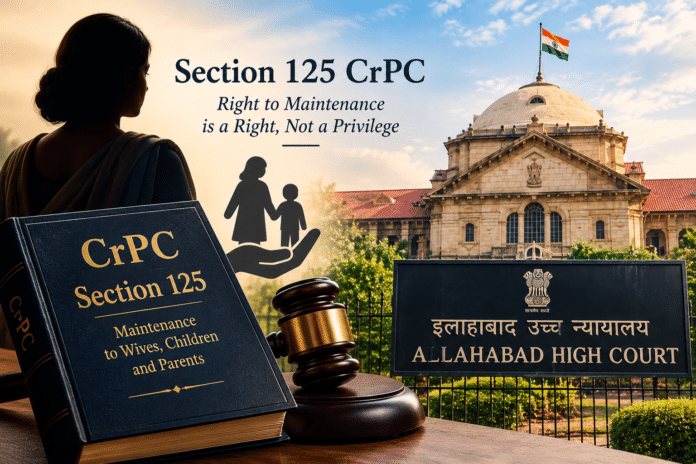
Allahabad High Court holds that divorce on grounds of desertion does not bar a woman from claiming maintenance under Section 125 CrPC after divorce.
The Court held that a divorced woman continues to fall within the statutory definition of “wife” under Section 125 CrPC and can seek maintenance until she remarries or becomes capable of maintaining herself.
The Allahabad High Court has held that a woman does not lose her right to claim maintenance under Section 125 of the Code of Criminal Procedure (CrPC) merely because her marriage was dissolved on the ground of desertion.
Justice Ram Manohar Narayan Mishra held that although desertion may affect a wife’s entitlement to maintenance while the marriage subsists, a divorced woman continues to be treated as a “wife” for the limited purpose of Section 125 CrPC. The entitlement continues until she remarries or becomes capable of maintaining herself.
The Court made the observation while allowing a criminal revision filed by a woman challenging the rejection of her maintenance claim by the Family Court, Sultanpur.
Marriage, Desertion And Divorce
The revisionist had married the opposite party according to Hindu rites and rituals during childhood, with her gauna taking place about nine years later. A child was born from the marriage.
According to her allegations, after the gauna, her husband joined the Indian Army as a Naik/Driver. She alleged that from 2007 onwards, she was subjected to cruelty and harassment by her husband and his family over additional dowry demands.
She further alleged that an attempt was made to set her on fire in February 2007 and that she subsequently approached the authorities seeking protection and maintenance.
The woman initiated proceedings under Section 125 CrPC in 2009. During the proceedings, the husband contended that she had deserted him without sufficient reason and refused to return to his parental home.
The husband subsequently instituted divorce proceedings under the Hindu Marriage Act. An ex-parte divorce decree was passed on September 25, 2014, on the ground of desertion. He later remarried.
Family Court Rejected Maintenance Claim
The Family Court, Sultanpur had dismissed the woman’s application under Section 125 CrPC in December 2018.
The Family Court held that she had failed to establish sufficient and reasonable grounds for living separately from her husband. It also noted that 15% of the husband’s salary had been deducted through Army authorities towards maintenance.
Before the High Court, however, it was pointed out that the deduction was specifically made for the maintenance of the minor son and did not amount to maintenance being granted to the revisionist herself. The Army authorities later discontinued the deduction after the husband’s discharge from service and advised her to approach the civil court.
Does Desertion Prevent Maintenance After Divorce?
The central issue before the High Court was whether a woman against whom a decree of divorce had been passed on the ground of desertion could subsequently claim maintenance under Section 125 CrPC.
The High Court answered the question in the affirmative.
The Court relied substantially on the Supreme Court’s decision in Rohtash Singh v. Smt. Ramendri, which had considered the relationship between Section 125(4) CrPC and the statutory status of a divorced woman.
Section 125(4) provides certain circumstances in which a wife is disentitled from receiving maintenance, including where she is living in adultery, refuses to live with her husband without sufficient reason, or the parties are living separately by mutual consent.
The High Court noted that these conditions presuppose the existence of a subsisting matrimonial relationship. Once the marriage itself has been dissolved by a decree of divorce, the question of whether the woman has sufficient reason to live separately from her husband no longer arises in the same manner.
Divorced Woman Retains Status Of “Wife” For Maintenance
The Court further relied upon Explanation (b) to Section 125(1) CrPC, which expressly includes a divorced woman who has not remarried within the meaning of “wife” for the purposes of the provision.
The High Court therefore held that the divorce decree on the ground of desertion could not completely extinguish the woman’s statutory entitlement to seek maintenance after dissolution of the marriage.
The Court observed that a divorced woman remains entitled to maintenance until she remarries or is capable of maintaining herself through her own earnings, subject to the statutory requirements.
Applying this principle, the Court held that the revisionist was entitled to seek maintenance from her former husband from the date of divorce, i.e. September 25, 2014.
High Court Sets Aside Family Court Order
The High Court found that the Family Court had committed legal and factual errors in completely rejecting the woman’s maintenance application.
It accordingly set aside the December 22, 2018 order and remitted the matter to the Family Court, Sultanpur for fresh consideration in accordance with law.
The Family Court was directed to conclude the proceedings expeditiously, preferably within six months. Both parties were also directed to submit affidavits disclosing their assets, income and liabilities in accordance with the Supreme Court’s guidelines in Rajnesh v. Neha.
Pending final adjudication, the High Court directed the husband to pay ₹4,000 per month as interim maintenance to the revisionist, subject to adjustment against any final amount determined by the Family Court.
The Court separately held that the minor child was entitled to maintenance until attaining majority, excluding the period for which maintenance had already been received through the Army authorities.
What The Ruling Clarifies
The decision draws an important distinction between desertion as a ground for divorce and the statutory entitlement of a divorced woman to seek maintenance.
A divorce decree against a woman on the ground of desertion does not, by itself, permanently disqualify her from invoking Section 125 CrPC. The Court’s reasoning is that the statutory status of a divorced woman under the provision operates independently after dissolution of marriage, subject to conditions such as remarriage and her ability to maintain herself.
For more developments from the National Legal News section, follow The Legal Observer. Readers can also explore the publication’s latest legal news for updates from courts across India.
The case is Smt. Suneeta v. State of U.P. & Anr., Criminal Revision No. 254 of 2019, decided by Justice Ram Manohar Narayan Mishra on September 18, 2026.
Further legal updates are available through The Legal Observer’s YouTube channel.