The Supreme Court declines a plea seeking to reduce the minimum age to contest Parliamentary and State Assembly elections in India.
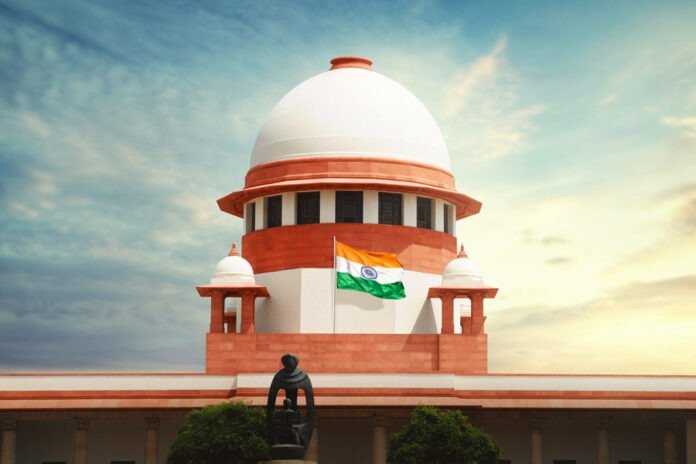
The Supreme Court has refused to entertain a petition seeking a reduction in the minimum age requirement for contesting Parliamentary and State Legislature elections, observing that judicial intervention in the matter would not be appropriate.
Supreme Court Refers Petitioner To High Court For Relief Under Article 226
The petition, titled Nalla Suresh Reddy vs Union of India, was considered by a Bench comprising Justice Vikram Nath and Justice Aparesh Kumar Singh on November 28, 2026. During the hearing, the petitioner’s counsel argued that the plea raised an important constitutional and democratic issue concerning the difference between the minimum voting age and the minimum age prescribed for contesting elections.
The counsel submitted that while the voting age had been reduced from 21 to 18 years through the 61st Constitutional Amendment, the minimum age for becoming an elected representative remained considerably higher.
The Bench, however, was not inclined to entertain the petition. Expressing its reservations, the Court observed, “This is not an appropriate petition.”
Following the Court’s response, the petitioner’s counsel sought a limited direction requiring the concerned authorities to consider and decide a representation that had already been submitted in relation to the issue.
The Bench indicated that the petitioner could approach the jurisdictional High Court under Article 226 of the Constitution to seek appropriate relief. Justice Vikram Nath reportedly told the counsel, “For that, you can go to the High Court under Article 226.”
Thereafter, the counsel sought permission to withdraw the petition. The Supreme Court allowed the request and dismissed the matter as withdrawn. Bar and Bench – Indian Legal news
Existing Constitutional Provisions On Minimum Age
The minimum age requirements for contesting elections are expressly provided under the Constitution of India. Article 84 prescribes the qualifications for membership of Parliament, while Article 173 deals with qualifications for membership of State Legislatures.
Under the existing constitutional framework, a person must satisfy the following age requirements:
- Lok Sabha: A minimum age of 25 years.
- Rajya Sabha: A minimum age of 30 years.
- State Legislative Assembly: A minimum age of 25 years.
- State Legislative Council: A minimum age of 30 years.
These provisions establish different eligibility thresholds depending on the legislative body. Therefore, even though an individual becomes eligible to vote upon attaining the age of 18 years, the same individual must wait until attaining the prescribed minimum age before contesting elections to the Lok Sabha or a State Legislative Assembly.
Any reduction in these constitutional age requirements would require an appropriate constitutional amendment by Parliament.
61st Constitutional Amendment and the Voting Age
The petitioner’s argument primarily relied upon the 61st Constitutional Amendment Act, 1988, which reduced the minimum voting age from 21 years to 18 years by amending Article 326 of the Constitution.
The amendment was introduced to provide younger citizens with an opportunity to participate in the democratic and electoral process at an earlier age. It reflected the recognition that individuals attaining the age of 18 years should have a meaningful role in determining the political future of the country.
The petitioner sought to extend a similar principle to electoral candidature, arguing that young citizens who are considered mature enough to exercise their voting rights should also have an opportunity to participate directly in electoral politics by contesting elections.
The plea thus sought to bring greater consistency between the minimum age for exercising electoral rights and the minimum age for seeking an electoral mandate.
However, the Supreme Court’s decision to decline interference means that the existing constitutional age requirements continue to remain unchanged.
Legislative Reform Rather Than Judicial Intervention?
The proceedings bring attention to an important constitutional question concerning the respective roles of the judiciary and Parliament in determining electoral eligibility.
While the Supreme Court exercises the power of judicial review to examine constitutional and legal questions, changing an express constitutional qualification ordinarily requires legislative action through the constitutionally prescribed amendment process.
The petitioner’s request also raises a wider discussion about youth participation in Indian democracy. With citizens becoming eligible to vote at 18, the difference between voting eligibility and candidature eligibility remains an important subject of electoral reform.
A reduction in the minimum age for contesting elections could potentially widen opportunities for younger political representatives and encourage greater participation of youth in legislative institutions. At the same time, the existing age requirements reflect the constitutional framework chosen for membership of Parliament and State Legislatures.
The Supreme Court, however, did not examine the merits of the proposed reduction or declare the existing age requirements unconstitutional. Its decision was limited to declining to entertain the petition and permitting its withdrawal.
A Question That Remains Open For Consideration
The withdrawal of the petition leaves the broader issue of reducing the minimum age for contesting elections open for consideration before the appropriate constitutional and legislative forums.
The observation permitting the petitioner to approach the High Court under Article 226 provides an alternative legal avenue concerning the pending representation. However, such proceedings would not, by themselves, alter the constitutional age qualifications.
The matter also highlights the continuing debate over the extent of youth representation in India’s democratic institutions. Whether the minimum candidature age should be aligned more closely with the voting age is ultimately a question involving constitutional policy and legislative consideration.
For now, the minimum age requirements prescribed under Articles 84 and 173 remain applicable. The Supreme Court’s order in Nalla Suresh Reddy vs Union of India does not bring about any change in the existing electoral eligibility framework.
The development is another reminder that meaningful electoral reform requires not only judicial scrutiny but also appropriate constitutional and parliamentary action. Readers can follow further developments concerning Indian constitutional and electoral law through The Legal Observer and its official video coverage.