
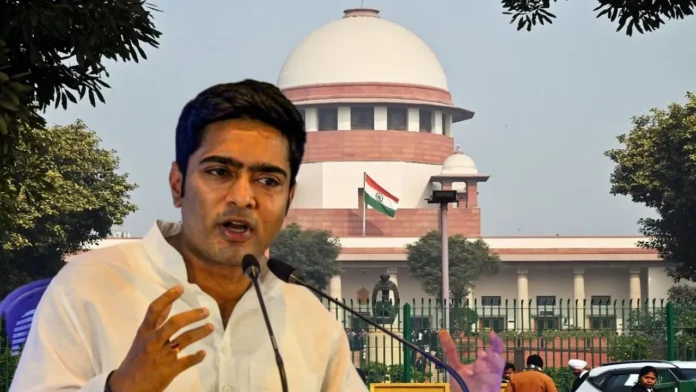
Solicitor General tells Supreme Court that Lok Sabha Speaker issued notices to 20 rebel MPs on TMC disqualification pleas under the anti-defection law.
The Supreme Court was hearing a plea by TMC General Secretary and Lok Sabha leader Abhishek Banerjee seeking an expeditious decision on the disqualification petitions.
Solicitor General of India Tushar Mehta informed the Supreme Court on Tuesday that Lok Sabha Speaker Om Birla has issued notices to 20 rebel MPs in connection with petitions filed by the Trinamool Congress (TMC) seeking their disqualification under the anti-defection law.
The submission was made before the Supreme Court while hearing a writ petition filed by TMC General Secretary and Lok Sabha leader Abhishek Banerjee, who has sought an expeditious decision by the Speaker on the disqualification petitions.
The development comes against the backdrop of the constitutional framework governing defection by elected representatives. The Tenth Schedule of the Constitution, commonly referred to as the anti-defection law, provides for disqualification of members of Parliament and State Legislatures in specified circumstances.
The matter is significant because petitions seeking disqualification of legislators under the Tenth Schedule are decided by the concerned Speaker or Chairman. The TMC’s plea before the Supreme Court seeks intervention to ensure that the petitions pending before the Lok Sabha Speaker are considered and decided without undue delay.
During Tuesday’s proceedings, Solicitor General Tushar Mehta apprised the bench that the Speaker has already taken a step on the petitions by issuing notices to the 20 MPs concerned. The submission indicates that the disqualification proceedings have moved forward at the level of the Lok Sabha.
The Supreme Court was considering the plea in the context of the petitioner’s request for an expeditious decision. With notices having been issued, the next stage would involve consideration of the responses of the MPs concerned and further proceedings before the Speaker in accordance with the applicable constitutional framework.
The Tenth Schedule was introduced to address the practice of elected representatives switching political allegiance in circumstances covered by the anti-defection provisions. Among other things, it lays down circumstances in which a member may face disqualification for voluntarily giving up membership of a political party or voting, or abstaining from voting, contrary to directions issued by the political party, subject to the provisions and exceptions contained in the Schedule.
The role of the Speaker in deciding disqualification petitions has repeatedly been the subject of constitutional litigation. Questions concerning the timing of such decisions can assume particular importance when the composition of a legislature or the political strength of parties is affected by the proceedings.
In the present case, the TMC approached the Supreme Court seeking an expeditious decision on its petitions concerning the 20 rebel MPs. The Solicitor General’s submission regarding the issuance of notices provides an indication that the Speaker has commenced consideration of the allegations and claims raised in the disqualification proceedings.
The Supreme Court proceedings therefore mark another stage in the dispute over the status of the 20 MPs and the TMC’s request for action under the anti-defection law.
The latest development is also relevant to broader discussions concerning legislative accountability and the functioning of the Tenth Schedule. While the Speaker is vested with the authority to decide disqualification petitions, challenges concerning delays in taking decisions have previously reached constitutional courts.
Readers can follow further developments through The Legal Observer’s News section and its National News coverage.
For continuing legal updates and developments from courts and legislatures, readers can also follow The Legal Observer’s YouTube channel.