
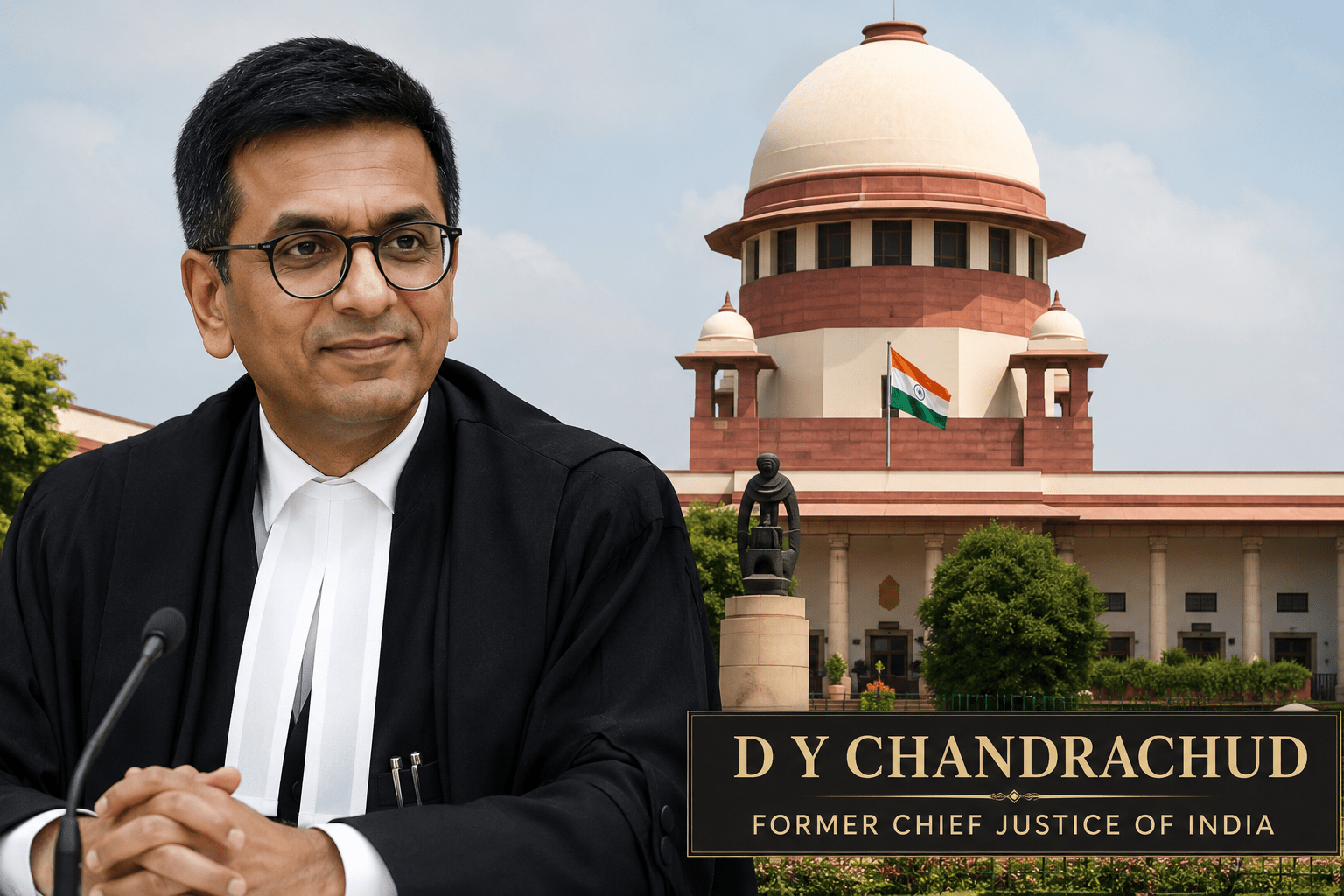
Justice Dhananjaya Yeshwant (D.Y.) Chandrachud is one of India’s most respected jurists, known for delivering several landmark judgments that have shaped constitutional law and individual rights. He served as the 50th Chief Justice of India (CJI) from 9 November 2022 to 10 November 2024, leaving behind a legacy of judicial reforms, technological innovation, and constitutional values.
Early Life and Family
D.Y. Chandrachud was born on 11 November 1959 in Mumbai, Maharashtra. He belongs to a distinguished legal family.
His father, Justice Yeshwant Vishnu Chandrachud, was India’s longest-serving Chief Justice, serving from 1978 to 1985. His mother, Prabha Chandrachud, was a classical musician and an artist associated with All India Radio.
Justice Chandrachud is married to Kalpana Das, and the couple has two sons. One of them, Abhinav Chandrachud, is a well-known lawyer, legal scholar, and author. The family has also fostered two daughters.
Education
Justice Chandrachud completed his schooling and higher education in India before pursuing advanced legal studies in the United States.
His academic qualifications include:
- B.A. (Economics), St. Stephen’s College, University of Delhi
- LL.B., Campus Law Centre, University of Delhi
- LL.M., Harvard Law School
- Doctor of Juridical Science (S.J.D.), Harvard Law School
His education at Harvard significantly influenced his approach to constitutional law and comparative legal studies.
Legal Career
Justice Chandrachud began practising law at the Bombay High Court and the Supreme Court of India. His expertise in constitutional and commercial law quickly earned him recognition.
Career Timeline
- Practised as an advocate in the Bombay High Court and Supreme Court.
- Appointed Additional Solicitor General of India in 1998.
- Became a Judge of the Bombay High Court in 2000.
- Appointed Chief Justice of the Allahabad High Court in 2013.
- Elevated as a Judge of the Supreme Court of India in 2016.
- Served as the 50th Chief Justice of India from 9 November 2022 to 10 November 2024.
Landmark Judgments
Justice Chandrachud has been part of several historic constitutional decisions, including:
- Recognition of the Right to Privacy as a fundamental right.
- Judgments strengthening women’s rights and gender equality.
- Decisions promoting freedom of expression and digital rights.
- Important rulings concerning constitutional governance and civil liberties.
His opinions have frequently emphasised the protection of individual dignity, equality, and constitutional morality.
Judicial Reforms
As Chief Justice, Justice Chandrachud promoted several reforms aimed at improving access to justice. His tenure focused on:
- Expansion of digital court infrastructure.
- Greater transparency in judicial administration.
- Increased use of technology in court proceedings.
- Improving access to justice through virtual hearings and digitisation.
These initiatives modernised the functioning of the Indian judiciary and improved public access to the legal system.
Legacy
Justice D.Y. Chandrachud is regarded as one of India’s most progressive constitutional judges. His judgments have had a lasting impact on privacy, equality, civil liberties, and constitutional governance.
His commitment to judicial independence, technology-driven reforms, and protection of fundamental rights has made him one of the most influential Chief Justices in contemporary Indian legal history.
Conclusion
From his distinguished family background to his remarkable judicial career, Justice D.Y. Chandrachud has played a significant role in shaping India’s constitutional jurisprudence. His decisions and reforms continue to influence the legal landscape, making him one of the most respected figures in the Indian judiciary.