
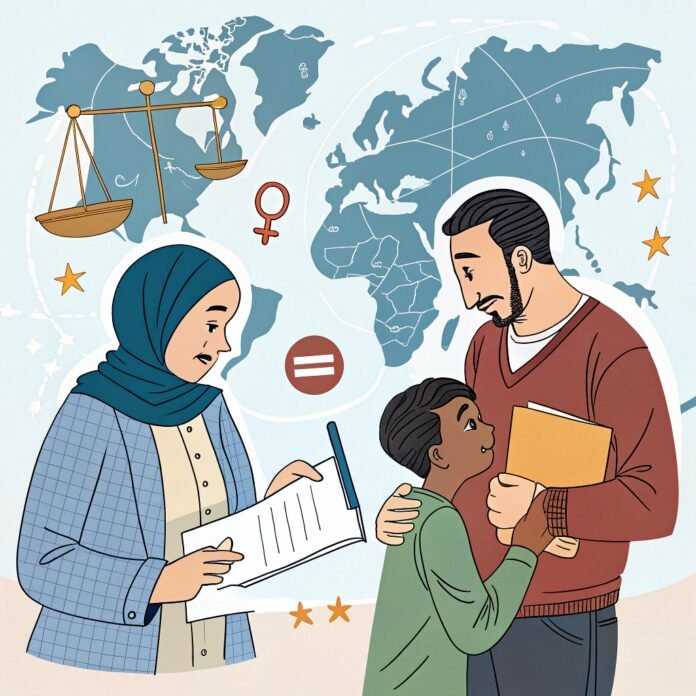
Procedural inequity in cross-border custody disputes highlights how jurisdictional rules can affect access to justice, outcomes, and parental rights.
While often viewed as neutral, procedural law can significantly shape outcomes in cross-border child custody disputes, raising concerns of fairness and access to justice.
Procedural law is commonly perceived as a neutral framework that merely facilitates the resolution of disputes without influencing their outcomes. It is also often assumed to be gender-agnostic. However, a closer examination reveals that procedure can be as decisive as substantive law, particularly in sensitive and complex matters such as cross-border child custody disputes.
In many Common Law jurisdictions, civil procedure determines where a lawsuit can be filed and which court has the authority to hear it. Typically, a civil claim may be instituted where the defendant resides or where the cause of action arises. Similarly, under Indian law, the Criminal Procedure Code (CrPC) lays down territorial limits within which police authorities may investigate offences and magistrates may take cognisance.
Over time, courts and lawmakers have acknowledged that territorial jurisdiction is not merely a technical requirement. It directly affects access to justice, litigation costs, and the practical ability of parties to pursue or defend claims. Recognising this, several branches of law—such as trademark disputes and arbitration proceedings—have seen an expanded interpretation of jurisdiction to accommodate commercial realities and convenience of parties.
However, this progressive approach has not evolved uniformly across all areas of law. In cross-border custody disputes, procedural rigidity often creates inequitable outcomes. Parents—frequently mothers—may find themselves compelled to litigate in foreign jurisdictions, far from their support systems, due to strict adherence to territorial or habitual residence principles.
Jurisdictional rules in custody matters are closely tied to concepts such as the child’s “ordinary residence” or “habitual residence.” While these principles are intended to discourage forum shopping and ensure stability for the child, they can inadvertently disadvantage one parent. A parent who relocates with a child—sometimes due to compelling circumstances—may be forced to defend custody proceedings in a country where they lack financial means, legal familiarity, or social support.
Indian courts, including the Supreme Court, have repeatedly grappled with the tension between procedural discipline and substantive justice in international custody cases. While emphasising comity of courts and respect for foreign judgments, the judiciary has also underlined that the welfare of the child remains paramount. Yet, procedural hurdles often delay substantive examination of welfare considerations.
The inequity is compounded by delays inherent in cross-border litigation. Securing service of notices, complying with foreign legal requirements, and navigating conflicting legal systems can take years. During this time, interim procedural orders—such as travel restrictions or custody arrangements—can effectively determine the final outcome, even before a full hearing on merits.
Legal scholars argue that this demonstrates how procedure shapes substance. Interim jurisdictional determinations, though procedural in nature, can have irreversible consequences for parental rights and the child’s upbringing. In this sense, procedural neutrality becomes an illusion.
Comparatively, areas like arbitration and intellectual property law have adapted jurisdictional rules to reflect fairness and convenience. For example, trademark owners are permitted to file suits where they conduct business, easing enforcement burdens. A similar rethinking is increasingly being advocated in family law, especially in transnational custody disputes.
There is a growing call for legislative and judicial reform to introduce flexible jurisdictional standards that prioritise access to justice without undermining child welfare. Some experts suggest specialised family courts with international jurisdictional competence or clearer statutory guidance on balancing comity with equity.
As India witnesses a rise in cross-border marriages and separations, these issues are no longer exceptional. The conversation around procedural inequity is therefore both timely and necessary. Readers can explore more discussions on evolving legal frameworks in the Insight section and broader debates on justice delivery at The Legal Observer.
Ultimately, ensuring fairness in cross-border custody disputes requires acknowledging that procedure is not a mere technicality. It is a powerful determinant of justice—one that must evolve to reflect social realities, protect vulnerable parties, and uphold the best interests of the child. More national and comparative perspectives on such issues are available in the National News and World-Wide sections.
For visual explainers and expert discussions on family law developments, readers may also refer to The Legal Observer’s YouTube channel.