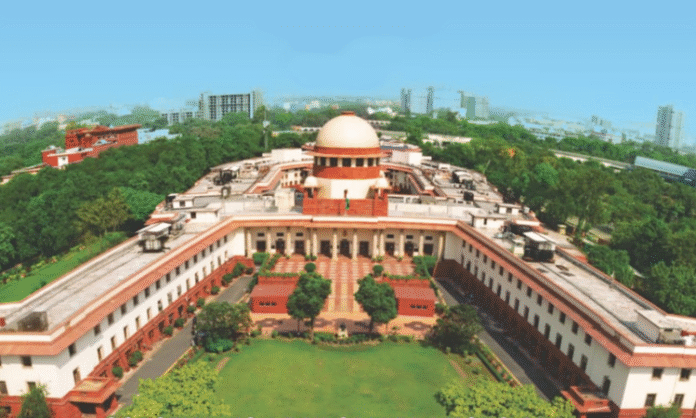
Supreme Court rules Delhi upper floors can be used commercially only after paying MCD conversion charges.
Supreme Court Clarifies Conversion Rules for Delhi Markets
In a key judgment impacting thousands of shop owners and residents in Delhi, the Supreme Court of India on Friday (October 31) upheld the sealing of a commercial establishment in New Rajinder Nagar Market for unauthorized use of upper floors originally designated for residential purposes.
While delivering the ruling, the Court clarified that upper floors in Local Shopping Centres (LSCs)—which were initially meant for residential use—can be converted for commercial activity only after payment of prescribed conversion charges to the Municipal Corporation of Delhi (MCD).
Bench Observations and Context
The Bench, led by Chief Justice of India B.R. Gavai, along with Justices K. Vinod Chandran and N.V. Anjaria, noted that the New Rajinder Nagar Market is categorized as a “designated LSC” (shop-cum-residence) and not a “planned LSC” (fully commercial).
This classification, the Court explained, means that the ground floors are intended for shops, whereas the upper floors were initially reserved for residential use. Any change in land use or occupancy must, therefore, comply with Delhi Master Plan regulations and MCD’s conversion policy.
“A property owner cannot convert the upper floors of a shop-cum-residence building into commercial premises without fulfilling statutory conditions,” the Bench observed, emphasizing that such use is permissible only after payment of conversion charges and due approval by MCD.
Legal Reasoning and Statutory Framework
The Court’s reasoning rests on the Delhi Municipal Corporation Act, 1957, the Master Plan for Delhi (MPD-2021), and relevant notifications governing mixed land use. Under these frameworks, Local Shopping Centres (LSCs) are divided into two categories — planned and designated.
- Planned LSCs: Areas developed and approved by municipal authorities as fully commercial spaces, where all floors may be used for trade or business.
- Designated LSCs (Shop-Cum-Residence): Markets where only the ground floors are meant for shops, and the upper floors remain residential unless converted legally.
The Court reiterated that this distinction exists to maintain urban balance, control traffic density, and ensure safety compliance. Arbitrary commercial use of upper floors, the Bench held, violates both zoning laws and building norms.
Implications for Property Owners and Traders
Legal experts suggest the ruling reinforces the principle that commercial convenience cannot override planned land use. Property owners in designated LSCs, such as those in Rajinder Nagar, Karol Bagh, and Lajpat Nagar, must ensure compliance with MCD’s prescribed conversion fee to regularize existing commercial activities.
According to a senior advocate practicing at the Delhi High Court, the verdict “restores much-needed discipline in municipal regulation.” The expert noted that many shop-cum-residence markets had been illegally converted into full commercial hubs, straining local infrastructure and parking facilities.
Another urban law specialist paraphrased the judgment as a warning to commercial establishments that “zoning and usage restrictions form an integral part of sustainable city planning” and must not be ignored for economic expediency.
Enforcement and Compliance Directions
The Supreme Court also directed the Municipal Corporation of Delhi to ensure strict enforcement of conversion rules while providing a transparent and accessible process for genuine applicants seeking regularization. The Bench encouraged MCD to publicly publish the schedule of conversion charges and maintain updated records to prevent misuse.
Additionally, it urged the civic body to strengthen coordination with the Delhi Development Authority (DDA) and Urban Development Department to create a uniform policy for mixed-use permissions across localities.
The Court observed that the unauthorized commercial use of residential spaces not only disturbs planned development but also compromises fire safety norms, and may lead to civic congestion.
“The sanctity of zoning must be preserved,” the Bench emphasized, adding that “planned urbanization cannot survive on selective compliance or retrospective regularization.”
Balancing Development and Regulation
Urban planners and legal commentators see the judgment as a balanced interpretation that upholds property rights while ensuring municipal discipline. The Supreme Court’s approach reflects the broader judicial commitment to planned urban growth — a recurring theme in Delhi’s regulatory challenges.
The decision may also serve as a precedent for pending disputes concerning similar commercial conversions in Karol Bagh, South Extension, and Laxmi Nagar, where the issue of illegal mixed use continues to burden civic authorities.
For further reading on urban development cases and legal interpretations of land use, visit The Legal Observer News Section. You can also watch analysis and expert insights on The Legal Observer’s YouTube Channel.