
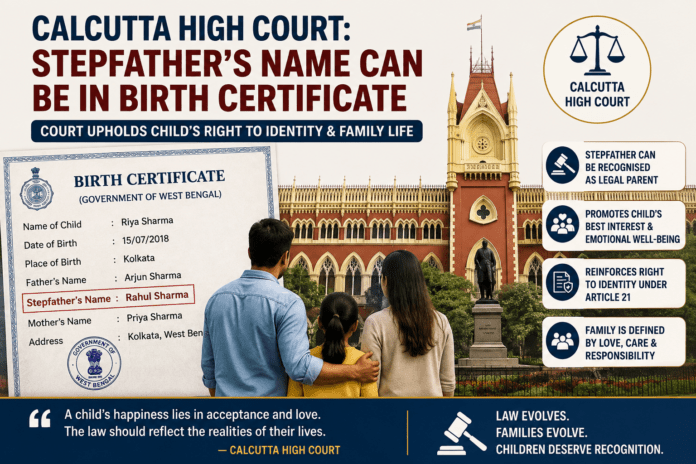
Calcutta High Court allows a stepfather’s name in a child’s birth certificate, holding that the change was in the minor’s best interest.
The Court observed that in today’s changing social circumstances, a child need not necessarily carry the name of his biological father where doing so is not in his best interest.
The Calcutta High Court has directed the municipal authorities to issue an addendum to a minor child’s birth certificate by incorporating the name of his stepfather and altering the child’s surname.
Justice Raja Basu Chowdhury passed the order while considering a mother’s plea seeking changes in the birth records of her minor son. The mother sought alteration of both the child’s surname and the name of his biological father in the official records.
The Court considered the circumstances surrounding the child’s upbringing and concluded that the requested changes were necessary in the “best interest of the minor child.”
Mother’s Plea Before The High Court
The petition was filed by the child’s mother seeking modification of the particulars recorded in her son’s birth certificate. She wanted the child’s surname to be changed and sought the incorporation of his stepfather’s name in place of the biological father’s name.
The issue required the Court to consider whether the birth certificate, once issued, could be supplemented to reflect the child’s present family circumstances.
Birth certificates are important official documents and ordinarily contain details concerning a child’s parentage and identity. However, the Court’s consideration in the present matter centred on whether continuing to reflect the biological father’s name would serve the welfare and interests of the child.
Court Focuses On Best Interest Of Child
The High Court ultimately directed the concerned municipal authorities to issue an addendum to the birth certificate incorporating the stepfather’s name and permitting the alteration of the child’s surname.
The Court’s approach places the welfare of the child at the centre of the dispute rather than treating biological parentage as the sole consideration for determining the name by which a child should be identified.
Justice Raja Basu Chowdhury observed that social and family structures have evolved considerably and that it may not always be necessary for a child to carry the name of the biological father.
The observation reflects the Court’s recognition that family relationships in contemporary society can take different forms and that legal documentation should, in appropriate circumstances, accommodate the child’s actual family environment.
Changing Understanding Of Family Identity
The ruling also highlights the importance of considering a child’s emotional and social well-being when questions concerning identity and official records arise.
A child’s surname can form an important part of his or her social identity. Where a stepfather is responsible for raising the child and forms part of the child’s immediate family environment, insisting upon retaining the biological father’s name may, depending on the circumstances, conflict with the child’s welfare.
The Court therefore considered the requested alteration from the perspective of what would benefit the minor rather than approaching the question solely through the biological relationship reflected in the original birth record.
The decision comes against the backdrop of a broader judicial recognition that the best interests of children must remain a central consideration in disputes involving their welfare, identity and family relationships.
Significance Of The Order
The Calcutta High Court’s order could have significance for similar cases where parents seek changes to children’s official records following changes in family circumstances.
At the same time, the order is based on the particular facts and circumstances placed before the Court. It does not mean that every request to replace a biological parent’s name with that of a step-parent would automatically be allowed.
The decision underscores that courts may examine the child’s circumstances and welfare while dealing with requests concerning birth records and identity.
The ruling thus reinforces the principle that the welfare and best interest of the child should remain paramount, particularly when rigid approaches to parentage and official documentation may not reflect the child’s present family life.
For more developments on Indian courts and important legal developments, readers can follow The Legal Observer‘s national legal news coverage.
External Link: The Legal Observer YouTube Channel — Watch The Legal Observer